Tuesday 9 June 2026

click on the trencherman logo at
top
to return to
our home page
© trencherman 2026 All rights reserved
 Espresso coffee is one of those things you either like or you don’t. We particularly enjoy coffee, in part because we’ve never drunk tea. Thus we’ve never got into Lapsang Souchong or Gunpowder Green Formosa, or whatever tea geeks drink. But we’re not sufficiently geeky about coffee that we buy unroasted beans and roast them ourseleves (although we did flirt with this many years ago) since if you have a coffee roaster what offers a decent range close at hand there seems little point. Good quality, supermarket-bought coffee (eg. Illy) is OK, but it is more likely to say “Best before” followed by some date many months into the future than “Roasted on (date)”. Even if it does show a roasting date (eg. Union), this will likely be several months ago. Buy from a dedicated coffee roaster (eg. Monsoon Estate) and it might even have been roasted that morning.
What we do know is that there are some fundamental principles for enjoying good coffee: it should ideally be freshly roasted, freshly ground and freshly made. Some vile brown liquid made from ground coffee that was bought months ago, in a machine that then stews it to death, is light years away from what you would drink standing up at the bar in Palermo.
Even if you prefer cappuccino (or latte or macchiato or whatever) to espresso, the espresso shot lies at the heart of all of these. This is the result of forcing water at about 95°C through ground coffee under nine bar of pressure for about 20-25 seconds, while the hallmark of a proper espresso is its ‘crema’ — the dense golden foam of emulsified coffee oils that captures the essence of the coffee flavour.
To create the perfect espresso the Italians believe you need the four Ms:
 macinadosatore (grinder) — with the grind size fine-tuned to match the bean type and roast characteristic: too coarse and the result will be too fast, too fine and it will be too slow. Ideally this is a burr grinder that operates slowly and does not heat the ground coffee.
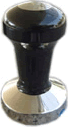
Over the 1980s and 1990s we owned a couple of cheap Gaggia machines, but these always eventually went wonky a year or so after you bought them by which time you could no longer get the spare parts. Then in 2005 we bought a Magimix Nespresso™ machine, which had a steam wand for cappuccinos and which produced OK espresso with a reasonable crema. After five years however the steam wand gave up** but we had in any event come to the conclusion that if you’re serious about coffee and don’t mind investing a bit of time and energy to get it right, you’ll always end up using a better machine, if for no other reason than you are no longer locked-in to the cost of Nespresso (or compatible) capsules. So in the autumn of 2010 we bought a espresso machine, which was a fairly serious piece of kit, with twin boilers (one for espresso, one for steam) and some Heath Robinson dials, together with a matching burr grinder. To recreate the sense of propping up the aforementioned bar in Palermo we got hold of some heavy espresso shot glasses, while a nice heavy tamper (from Bella Barista) completed the ensemble. However this too succumbed to the curse of earlier Gaggia machines and had to go.
**Nestlé seems to have decided that frothing milk using steam means there’s too much to go wrong, thus Nespresso machines no longer have this feature. Instead they sell you a gizmo that whisks (rather than steams) your milk, which is OK except that the resultant froth tastes like cardboard.
Fast forward to 2025 and...
